 how-to
How to Check UTV Tire Pressure Before Every Ride
Last Updated: November 3, 2026
Quick Summary
Check your UTV tire pressure before every ride. Tire pressure shifts with air temperature, load, terrain and time, so a setting that was right yesterday can be wrong today. Check cold tires with a gauge for the most accurate reading.
- Check each tire with a gauge before every ride, while tires are cold.
- Check again after big temperature changes, such as spring swings.
- Use the tire pressure and maximal load label on your UTV as your starting point.
- Adjust pressure in small steps for sand, mud, rocks or trail riding.
- Underinflated tires feel soft and wear the edges; overinflated tires feel harsh.
Table of Contents
- How Often to Check UTV Tire Pressure
- Finding the Right Recommended UTV Tire Pressure PSI
- Choosing a Best Digital Tire Pressure Gauge for Powersports
- How to Adjust UTV Tire Pressure for Different Terrains
- Signs Your Tires Are Under- or Over-Inflated
- Booking Your Next Gear Check at Monarch Sandbox
- Frequently Asked Questions
Most UTV owners set their tire pressure once and forget it. That habit costs more than people expect. Tire pressure shifts with air temperature, load, terrain and time, so a number that was right on Saturday can be wrong by Sunday. The National Highway Traffic Safety Administration reports that past studies found about 28% of light vehicles on U.S. roadways had at least one underinflated tire (NHTSA study on tire pressure maintenance). Off-road machines face the same physics, only harder.
Riders often ask how often to check UTV tire pressure. The short answer: before every ride. Here is why, and how to do it right.
How Often to Check UTV Tire Pressure
Check your UTV tire pressure before every ride, every time. To confirm the correct pressure and fitment for your tires, see how to verify powersports part fitment. Cold tires give the most accurate reading, so check them before you drive anywhere. Pressure can change quickly as the air around the tire warms or cools.
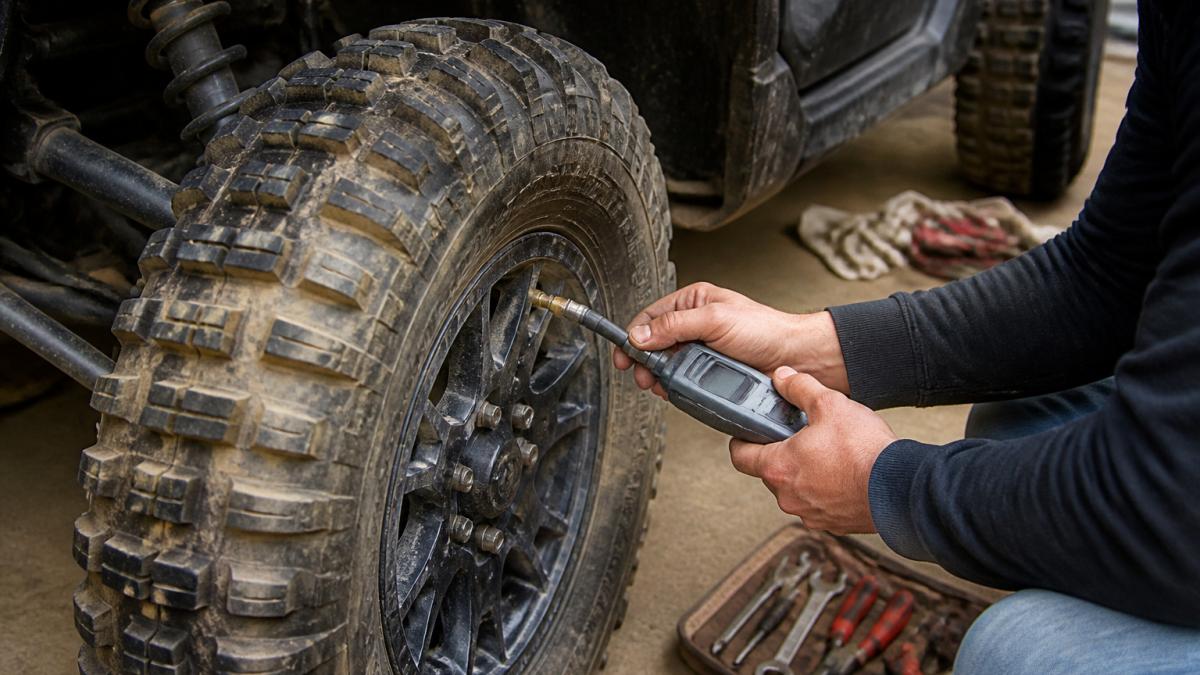
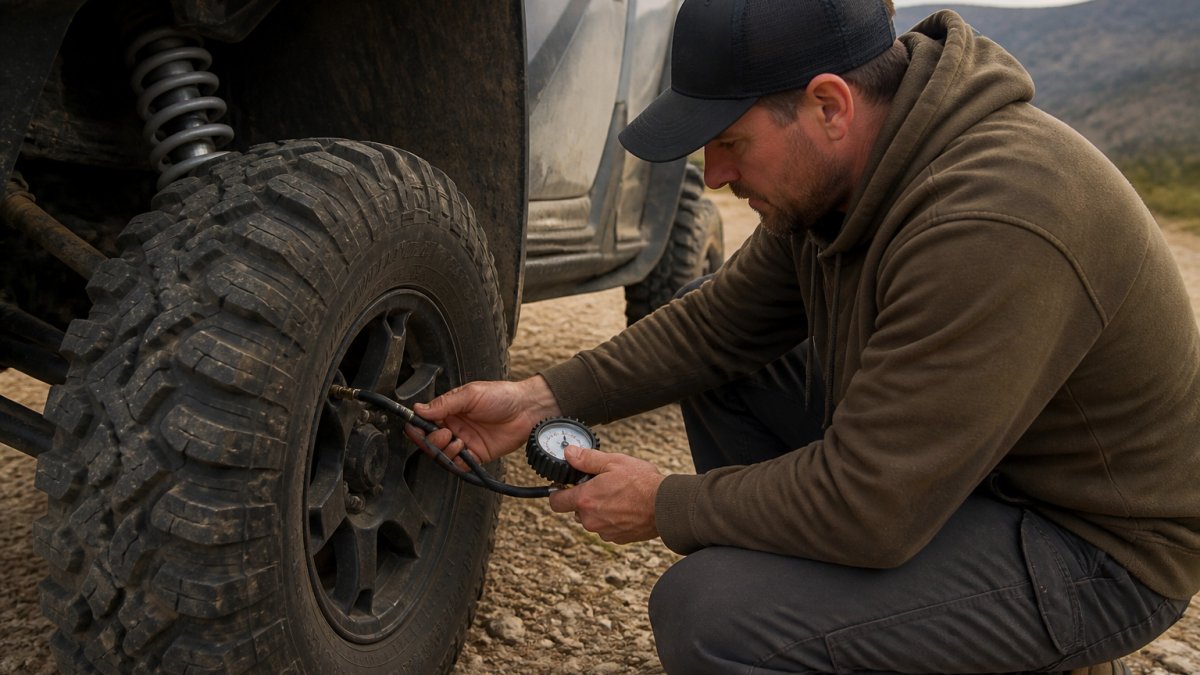
Before every ride, check each tire with a gauge. Do this when the tires are cold, meaning the machine has not been driven for a few hours. Write the numbers down if you ride often. Patterns show up fast.
[Insert link to our guide: how to verify powersports part fitment and correct tire specs | page:1]
After Temperature Swings and Seasonal Changes
Spring is a common time for pressure surprises. A morning ride in cold air can leave tires low by afternoon heat, or the reverse. UTV Source recommends checking tire pressure before every ride during spring, because temperature fluctuations can change it (UTV Source spring tire pressure guide).
- Check after any big temperature change
- Check after switching between shade and sun riding
- Check before long trips, not just short loops
The article's core advice is to check tire pressure before every ride, and it gives a few triggers for checking more often.
| Trigger | Action | When |
|---|---|---|
| Every ride | Check each tire with a gauge | Before every ride |
| Cold tires | Gives the most accurate reading | Before driving anywhere |
| Temperature swings | Recheck pressure | After big temperature change |
| Long trips | Check before departure | Not just short loops |
Finding the Right Recommended UTV Tire Pressure PSI
There is no single PSI for every UTV. Manufacturers set pressure for each model, so start with your owner's manual or the tire pressure and maximal load label. BRP directs Can-Am owners to that label to find the optimal pressure for their situation (BRP Can-Am tire pressure guidance).
Pressure also depends on load and terrain. A heavy rider with cargo needs a different setting than a light solo ride. Use the label as your starting point, then adjust within safe limits.
Choosing a Best Digital Tire Pressure Gauge for Powersports
Most UTV guides tell you to buy a gauge and move on. For a broader look at how powersports gear compares, see dirt bike helmet brands compared. The tool matters more than that, because a gauge that reads a pound or two off will have you chasing the wrong pressure all season. The real decision is digital versus analog, and each has a place in a UTV toolkit.
Digital gauges. A quality digital gauge reads to a fine step, often 0.1 PSI, and gives you an unambiguous number on a backlit display, which matters in low light or when you are crouched in dust. The trade-offs are battery dependence and sensitivity to drops and moisture. Look for a gauge rated for the pressure range you actually run (a 0-60 PSI gauge is more accurate at UTV pressures than a 0-150 PSI gauge), a clear display, a swivel or angled chuck that fits your valve stems, and a rugged housing with a good seal against dust and mud. A flexible hose helps on tight rear wheels.
Analog gauges. A dial gauge needs no battery, survives abuse, and gives an instant sweep reading. The catch is resolution and parallax: reading a dial to the nearest pound takes practice, and cheap dials drift out of calibration. A quality dial with a marked 1-PSI scale is a fine backup and a good choice for a glovebox tool you rarely touch.
The accuracy question. Consistency matters: pick one gauge as your reference, use it every time, and cross-check it against a second gauge now and then. If the two disagree by more than a pound or two, one of them is lying to you.
What to skip. Avoid pencil-style stick gauges for UTV work, they are hard to read accurately at low pressures and easy to lose. Avoid any gauge without a stated accuracy rating. And do not trust the gauge built into a cheap inflator without checking it against your reference gauge first.
Shop for more quality items @ →
Keep your reference gauge in the same spot in your toolkit so you always know where it is, and store it out of direct sun and moisture. A gauge that lives loose in a dusty bed will not stay accurate for long.
How to Adjust UTV Tire Pressure for Different Terrains
Terrain is the second variable after load, and it is where most riders leave performance on the table. The right approach is to treat your owner's manual pressure as a baseline for hard-packed trail riding, then tune in small steps for the surface you are actually on. Always adjust cold, and recheck after the tires heat up. Because the same attention to pressure and changing conditions matters when towing, make time to maintain trailer tires as carefully as you check your UTV tires.
Adjusting in 1-2 PSI steps and changing only one variable at a time makes it easier to find the setting that works. Drop pressure, ride a short loop, and feel for sidewall roll, steering effort and traction before dropping further. Write down what worked for each surface so you can return to it.
Sand and loose dunes. Lower pressure is the whole game here. A softer tire lengthens the footprint, which floats the machine on top of the sand instead of digging in. The floor is set by your wheel and tire combination, too low and you risk debeading on a hard landing or sharp turn. Watch out: a tire that feels great in a straight line in sand can roll off the bead in a hard sidehill, so creep up 1 PSI at a time until it stays seated.
Mud. You want a footprint wide enough to paddle but a tread pattern that can still clean itself. Slightly lower than trail pressure helps the lugs bite, but going too soft lets the tire balloon and pack mud into the tread instead of throwing it. Mud also hides rocks and roots, so do not go as low as you would in pure sand.
Rock crawling and technical trails. This is where low pressure gets expensive. A soft sidewall conforms to rocks and finds traction, but it also exposes the rim and bead to pinch flats and bent wheels. Watch out: running well below the label on rocks can pinch the tire against the rim and damage the bead, the traction gain is not worth a trailside wheel swap.
Hard-packed trail and gravel. This is your baseline. Run the manual pressure, or a pound or two below it if the machine feels skittish. Higher pressure here protects the sidewall, resists punctures from sharp gravel, and keeps the tread flat on the ground for predictable steering.
Snow and ice. Soft snow rewards a larger footprint much like sand does, but ice rewards control. A middle setting that keeps the tread flat and the sidewall supported is usually the safer compromise, and studs or chains change the calculus entirely.
After any terrain change, recheck pressure once the tires are warm. Heat from sustained riding can raise PSI, so recheck once the tires are warm.
Signs Your Tires Are Under- or Over-Inflated
Underinflated tires feel sluggish, squirm in corners and wear faster on the outer edges. Overinflated tires feel harsh, bounce on bumps and wear quickly in the center of the tread. Both can hurt handling, so check your tires any time the machine feels off.
- Under-inflated: soft steering, extra heat, uneven wear on the edges
- Over-inflated: harsh ride, skipping over bumps, center tread wear
Booking Your Next Gear Check at Monarch Sandbox
Checking tire pressure before every ride takes a minute and keeps your UTV safer and easier to handle. To keep your riding gear in good shape after each check, read tips for maintaining your dirt bike gear for longevity. Monarch Sandbox is an authorized Zero dealer, and we carry carefully selected gear and parts for riders who want to keep their machines in top shape. For current stock and pricing, visit our website or contact our team.
[Insert link to our guide: tips for maintaining your dirt bike gear for longevity | page:3]
Frequently Asked Questions
What is the ideal tire pressure for a UTV?
There is no single ideal number for every UTV. The correct pressure depends on the make and model, the tire size, the load you carry, and the terrain you ride. Start with the Tire Pressure and Maximal Load label on the vehicle, which manufacturers such as BRP use to specify pressure for each setup. Check pressure when the tires are cold, meaning before you have driven the vehicle, and use the printed range as your baseline. Adjust from that baseline only in small steps, and recheck after each change.
Does UTV tire pressure change with temperature?
Yes. Air contracts as temperatures drop and expands as they rise, so tire pressure falls in cold weather and climbs in heat. Spring temperature swings are a common reason pressure changes. Because temperature changes pressure, a tire set correctly in the morning may read differently by afternoon. Check cold, record your readings, and adjust for the conditions you expect to ride in.
Should I check UTV tire pressure before every ride?
Checking before every ride is the safest habit, especially when the weather changes or you move between terrains. Pressure can drift without anyone noticing, which is why a quick check before riding is useful. A quick reading takes under a minute and catches slow leaks, temperature-driven changes and valve problems before they affect handling on the trail.
Do I need a special gauge for UTV tires?
A good gauge is worth the investment. Digital gauges typically display readings to one-tenth of a PSI, which makes small adjustments easier to judge than with a basic dial gauge. Look for a gauge that reads in PSI, has a hose or swivel head that seats firmly on the valve stem, and holds its reading long enough for you to read it. Test your gauge against a second one occasionally, since any gauge can drift over time.