 how-to
How to Identify Genuine Performance Parts in 2026
Table of Contents
- Why Genuine Performance Parts Matter for Your Machine
- OEM vs Aftermarket Performance Parts: Know the Difference
- Step 1: Inspect Packaging and Labeling for Red Flags
- Step 2: Verifying Part Numbers for Powersports Components
- Step 3: Evaluate Material Finish and Build Quality
- Step 4: How to Spot Counterfeit Motorcycle Parts
- Use Digital Verification Tools and Authorized Dealers
- Your Genuine Parts Checklist and Final Verdict
- Frequently Asked Questions
Last Updated: September 7, 2026
Counterfeit parts now account for a significant share of the online powersports market, and the difference between a genuine component and a fake often comes down to millimeters of tolerance. Installing a knockoff brake caliper or suspension arm risks catastrophic failure at speed. Knowing how to identify genuine performance parts protects both your machine and your safety.
Genuine performance parts are components manufactured to the original equipment manufacturer's exact specifications, using certified materials and precise tolerances. Below is a step-by-step method to verify authenticity before you hand over your credit card.
Why Genuine Performance Parts Matter for Your Machine
The stakes go far beyond brand loyalty. A performance part must handle specific stress loads, heat ranges, and vibration frequencies. When a counterfeit fails, it often takes surrounding components with it.
Brake lines that burst under pressure or suspension bolts that shear mid-corner create immediate danger. Genuine parts also carry warranty support, while counterfeit sellers typically vanish when problems arise.
A genuine component installed once and maintained properly often outlasts three or four cheap imitations. Factor in the labor cost of repeated installation, and the "savings" from counterfeit parts evaporates quickly.
OEM vs Aftermarket Performance Parts: Know the Difference
Understanding the distinction between OEM and aftermarket performance parts is essential before you start inspecting boxes. OEM parts come directly from the vehicle manufacturer or their licensed suppliers, guaranteeing a perfect fit and factory-specified performance.
Aftermarket performance parts come from third-party manufacturers who specialize in upgrades. Quality varies dramatically. Reputable brands invest in research and development and stand behind their products. The danger zone is the unbranded or vaguely branded parts flooding marketplace sites at prices that seem too good to be true.
A common approach is using OEM parts for critical safety systems like brakes and steering, while trusting established aftermarket brands for upgrades like exhausts and air filters. The key distinction comes down to verifiable specifications and brand accountability.
| Part Type | Source | Best For | Risk Level |
|---|---|---|---|
| OEM | Manufacturer or licensed dealer | Brakes, suspension, engine internals | Low |
| Aftermarket (branded) | Established third-party brands | Exhaust, intake, cosmetic upgrades | Low to Medium |
| Aftermarket (unbranded) | Marketplace sellers, no clear brand | Nothing critical | High |
Step 1: Inspect Packaging and Labeling for Red Flags
Genuine parts ship in packaging that reflects the manufacturer's quality standards. Begin your inspection before you even open the box, as counterfeiters often cut corners on packaging.
Check the box for consistent branding, logo placement, and print quality. Genuine manufacturers use high-resolution printing with crisp edges. Blurry logos, mismatched fonts, or off-color graphics signal a rushed print job. Look for tamper-evident tape or sealed bags with the brand logo.
A genuine part label includes the manufacturer's full name and address, the part number, a barcode, and often a holographic security label. Missing regulatory marks or vague "imported by" statements are red flags. If the label looks like it was printed on a home inkjet printer, treat it as counterfeit.
Step 2: Verifying Part Numbers for Powersports Components
The part number is your most direct verification tool, yet many riders skip this step. Every genuine component has a unique part number that cross-references to the manufacturer's catalog. Verifying part numbers for powersports components requires checking this number against the official parts diagram for your specific make and model.
Locate the part number on the component itself, not just the box. Genuine parts have the number stamped, cast, or laser-etched directly into the material. A part number that appears only on a stick-on label is a common counterfeit indicator.
Cross-reference the number using the manufacturer's official online parts catalog. Many manufacturers offer digital lookup tools where you enter the part number to confirm fitment. Pay attention to slight variations in the number sequence, as counterfeiters sometimes use numbers that are visually similar but off by a digit.
Compare the part number against your vehicle's service manual. If the number on the part differs from the manual or the official catalog, you're likely holding a counterfeit or a part intended for a different application.
Step 3: Evaluate Material Finish and Build Quality
Once the packaging and part number pass inspection, shift your attention to the component itself. Genuine performance parts display consistent material finish and machining quality that is difficult and expensive to replicate.
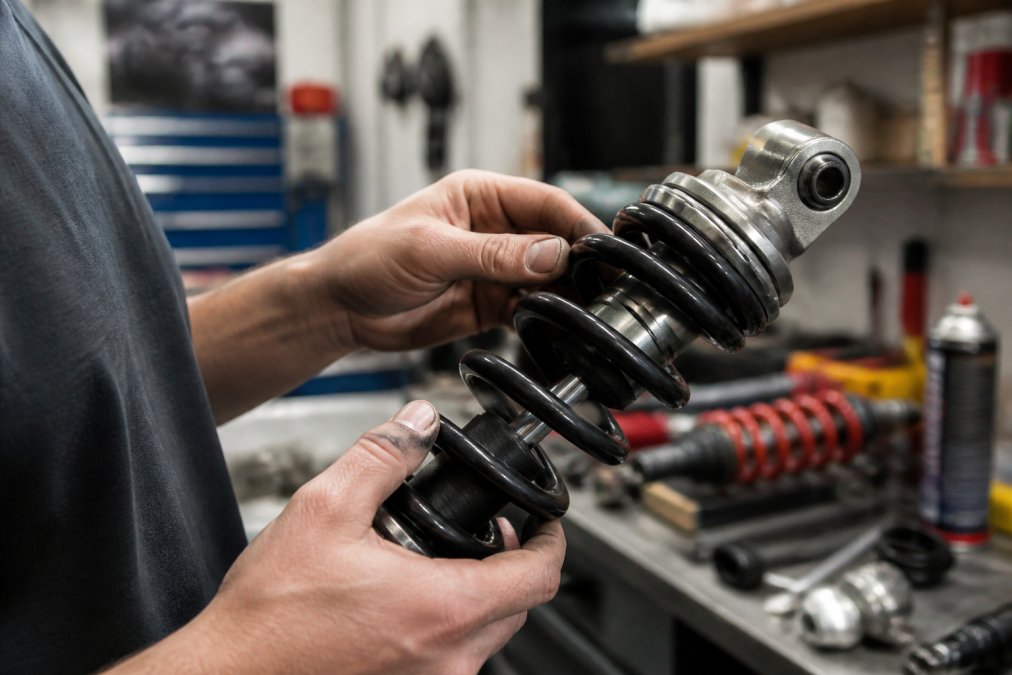
Run your fingers along the machined surfaces. Genuine parts feature smooth, uniform machining marks with no tool chatter or rough edges. Counterfeit parts often exhibit pitting, uneven surfaces, or visible mold lines that indicate lower-quality manufacturing processes.
Examine the surface treatment. Genuine parts use consistent anodizing, plating, or coating applied evenly. Faded, patchy, or flaking coatings suggest shortcuts in the treatment process.
Check the weight of the component. A part that feels noticeably lighter or heavier than expected may use inferior material with different structural properties. Compare the bolt holes and mounting points for proper tolerance. Genuine parts fit precisely without forcing, while counterfeits often require persuasion to align.
Step 4: How to Spot Counterfeit Motorcycle Parts
Learning how to spot counterfeit motorcycle parts requires knowing where manufacturers place their security features and understanding the specific failure modes of high-risk components. The most valuable skill is knowing what to check on the parts most likely to be counterfeited: brake pads, oil filters, and suspension components.
Case Study: Brake Pads
Brake pads are one of the most commonly counterfeited performance parts because they are small, expensive, and easy to replicate poorly. A genuine pad from a major brand like Brembo or EBC uses a specific friction compound formulated to perform at high temperatures without fading. Counterfeit pads often use a generic compound that fails under hard braking.
Visual check: Genuine brake pads have a clean, uniform friction surface with no cracks or voids. The backing plate is precision-stamped with the brand logo and part number. Counterfeit pads often have rough edges on the backing plate and a friction surface that feels chalky or crumbly.
Weight check: Weigh the pad on a kitchen scale. A genuine pad will be within a few grams of the manufacturer's published weight. Counterfeit pads are often lighter because they use less friction material or a thinner backing plate. If a pad is 20 percent lighter than expected, that is a strong indicator of a counterfeit.
The burnish test: If you have already installed the pad, pay attention to the initial break-in. Genuine pads require a specific bed-in procedure and will gradually increase braking power. Counterfeit pads often grab aggressively at first and then fade quickly as the friction material overheats and glazes over.
Case Study: Oil Filters
Oil filters are another high-volume counterfeit target. A genuine filter from a brand like K&N or Mobil 1 uses high-quality filter media that traps particles down to a specific micron rating. Counterfeit filters often use paper media that collapses under oil pressure, allowing unfiltered oil to circulate through the engine.
Visual check: Examine the filter's canister. Genuine filters have a smooth, consistent paint finish with the brand name and part number printed clearly. Counterfeit filters often have uneven paint, a rough crimp where the canister meets the base plate, and a rubber gasket that feels hard or brittle. avoiding fake products.
The internal check: If you have a used genuine filter and a suspected counterfeit, cut both open with a hacksaw. The genuine filter will have a pleated paper element that is tightly packed and evenly spaced. The counterfeit will often have fewer pleats, wider spacing, or a different filter media that looks like cardboard.
Anti-drainback valve: Genuine filters have a silicone anti-drainback valve that prevents oil from draining out of the filter when the engine is off. On a counterfeit, this valve is often missing or made of a thin, hard plastic that will not seal properly.
Case Study: Suspension Components
Suspension arms, linkages, and bolts are critical safety parts that are increasingly counterfeited. A genuine suspension arm is forged from a specific aluminum alloy and then heat-treated to achieve the required strength. Counterfeit arms are often cast from a cheaper alloy and may not be heat-treated at all.
Visual check: Look for the forging marks. Genuine forged arms have a smooth, continuous grain structure with no visible parting lines. Cast counterfeit arms will have a visible parting line running along the center of the part. Also, check the bolt holes. Genuine parts have precisely drilled and reamed holes with no tool marks. Counterfeit holes may be rough or slightly oversized.
Magnetic test: Some counterfeit suspension parts are made from steel that has been painted to look like aluminum. Run a magnet over the part. If it sticks, the part is not aluminum.
The torque test: When you install a genuine suspension bolt, it will thread smoothly and reach the specified torque with a clean, consistent feel. A counterfeit bolt may bind, feel gritty, or reach torque at a different point than expected. If a bolt requires significantly more force to turn than the service manual specifies, stop and inspect the threads.
The Serial Number Deep Dive
Many manufacturers engrave serial numbers on critical components like engine parts or ECUs. The engraving on genuine parts is clean and uniform, often using a dot-peen or laser process. Counterfeits often show uneven or shallow engraving, or use a font that is slightly different from the genuine part.
Compare the serial number format to a known genuine part or to images on the manufacturer's website. Pay attention to the number of digits, the use of dashes or spaces, and the font style. A common counterfeit error is using a serial number format from a different model year or product line.
If the component has a serial number, check it against the manufacturer's online verification portal. This is the most reliable method, as it ties the physical part to the manufacturer's production database. A serial number that does not return a match is a definitive counterfeit indicator.
Use Digital Verification Tools and Authorized Dealers
Most verification guides stop at physical inspection, but the most sophisticated counterfeiters now replicate packaging, holograms, and even part numbers. The modern line of defense is digital authentication, which ties a physical part to a manufacturer-controlled database.
QR Code Scanning: What to Look For
QR codes on genuine packaging are not just a square of random dots. They encode a unique, one-time-use token that links to the manufacturer's verification server. When you scan a genuine code, the resulting webpage should show the exact part number, a product image, and a confirmation that the code has not been previously checked.
A common counterfeit trick is to print a QR code that links to a fake website that mimics the manufacturer's portal. Before you scan, check the URL in your browser's address bar. It should be the manufacturer's official domain (e.g., www.brand.com/verify), not a lookalike domain like brand-verify.net or brandverification.co. If the page asks for personal information beyond a simple confirmation, that is a red flag.
Also, pay attention to whether the code has been scanned before. Most manufacturer portals will display a message like "This code has already been verified on [date]." If you see that, and you are the first owner of the part, it suggests the code was lifted from a genuine box and reprinted on a counterfeit.
NFC Chips and App-Based Verification
Some premium brands embed NFC chips inside the part itself or under the label. When you tap your smartphone to the chip, a dedicated app reads a unique identifier and checks it against the manufacturer's database. This is harder to counterfeit than a printed code because it requires physical access to the chip's cryptographic signature.
To use this method, download the manufacturer's official app from the Apple App Store or Google Play Store. Do not download an app from a link on the packaging or a third-party website, as those could be malicious. Once the app is installed, hold your phone's NFC reader against the marked area on the part. The app should return a confirmation screen with the part's serial number and production date.
Manufacturer Online Portals
If your part has a serial number but no QR code or NFC chip, use the manufacturer's official online verification portal. These portals are typically found under a "Product Authentication" or "Anti-Counterfeit" link in the website's footer. Enter the serial number exactly as it appears on the part, including any dashes or letters. The portal should confirm the serial number's validity and often provides the production batch date.
A genuine serial number will always return a match. If the portal returns an error or "serial not found," the part is almost certainly counterfeit. Some manufacturers also allow you to upload a photo of the part for visual confirmation, though this response can take a few business days.
The Authorized Dealer Supply Chain
The most reliable method for confirming authenticity is purchasing through authorized dealers. When you buy from an authorized dealer, the supply chain is traceable from the manufacturer to your hands, eliminating the counterfeit risk entirely. Authorized dealers also provide warranty support and technical assistance that marketplace sellers cannot match.
If you are buying online, verify the seller's authorized dealer status through the manufacturer's website. Most manufacturers publish dealer locator tools. A seller claiming to offer genuine parts without authorized dealer status is either sourcing through gray market channels or selling counterfeits. Gray market parts may be genuine but are not intended for sale in the U.S. market, which means they may lack the required regulatory certifications and warranty coverage.
The National Insurance Crime Bureau's vehicle parts guidance emphasizes that counterfeit parts often lack proper certification markings required for safety-critical applications. Similarly, the U.S. Consumer Product Safety Commission's counterfeit awareness resources highlight that fake components frequently fail to meet basic safety standards, creating hazards for consumers who unknowingly install them.
What to Do When Digital Verification Fails
If a part fails any digital verification step, do not install it. Document the failure with screenshots and photos of the part, packaging, and any codes. Then report the suspected counterfeit to the manufacturer's anti-counterfeit department and to the U.S. Customs and Border Protection's Intellectual Property Rights Center if the part was imported. Reporting helps manufacturers refine their authentication methods and helps authorities identify smuggling routes.
A common pattern is that counterfeiters will offer a "refund" if you return the part quietly. Do not accept this. The part will simply be resold to another buyer. Instead, keep the part if possible, as it may be needed as evidence for an investigation. Most manufacturers will replace a confirmed counterfeit with a genuine part at no cost, as they value the intelligence you provide.
Your Genuine Parts Checklist and Final Verdict
Before making your final decision, run through this verification checklist. A genuine part should pass every check, not just some of them.
- Packaging shows consistent branding, high-quality printing, and no damage
- Label includes full manufacturer information and a scannable barcode
- Part number on the component matches the official catalog and service manual
- Holographic security labels shift color and show multi-layered imagery
- Material finish is smooth with no rough edges, pitting, or excess flash
- Weight feels consistent with the expected material specification
- Serial number (if present) is cleanly engraved and uniform
- Seller is an authorized dealer or the QR/NFC verification passes
The reality is that counterfeiters continuously improve their methods. Packaging that fooled inspectors last year gets replicated this year. The strongest defense combines multiple verification methods with a trusted supply chain.
If you want to eliminate the guesswork entirely, source your components through a dealer with a verified supply chain and a reputation to protect. At Monarch Sandbox, we stock carefully selected performance parts and components from authorized distributors, ensuring every item we ship traces back to the manufacturer. Our team can help you verify fitment for your specific motorcycle, ATV, or side-by-side model before you order.
Frequently Asked Questions
How can I tell if a performance part is genuine OEM?
Start by verifying the part number against the manufacturer's official catalog or website. Genuine OEM parts have precise packaging with consistent branding, a clear part number, and often a holographic security label. Compare the part's weight and material finish to the original component you are replacing. Genuine parts have smooth machining marks and no rough edges. If the price is far below authorized dealer pricing, that is a strong sign it may be counterfeit or low-quality aftermarket.
Is OE or OEM better for my powersports vehicle?
OE (Original Equipment) parts are made by the same supplier that produced the part for the vehicle manufacturer and are identical to what came on the machine. OEM (Original Equipment Manufacturer) parts are made by that same supplier but sold under their own brand. Both meet the original specifications and tolerances. The main difference is packaging and warranty support. An OEM part can be a cost-effective way to get genuine quality, but verify the part number to ensure correct fitment for your specific model.
What are the most common signs of counterfeit parts?
Common signs include packaging with blurry logos, misspelled words, or missing holographic stickers. The part itself may have rough edges, uneven casting, or poor surface treatment compared to a genuine piece. Check the weight; counterfeit parts often feel lighter because they use cheaper materials. Also, look for an incorrect part number or a label that looks tampered with. If the branding or logo on the part does not match the manufacturer's official design, treat it as suspect.
Can a VIN lookup verify the authenticity of a performance part?
A VIN lookup confirms which parts originally came on your specific vehicle model and year. It does not directly verify the authenticity of a new part you are buying. Use the VIN to get the correct OEM part number for your machine. Then, cross-reference that number with the part you are considering. If the numbers do not match, the part is not the correct one for your vehicle, regardless of how genuine it appears. This step prevents fitment issues and wasted time.
Identifying genuine performance parts takes a few extra minutes, but the payoff is reliability, safety, and performance that actually matches the specifications. The cost of a counterfeit failure far exceeds any short-term savings. When you need parts you can trust, explore our curated selection of verified components and ride with confidence. Shop now and get the genuine parts your machine deserves.