 ultimate-guide
Choosing Protective Motocross Gear for Kids: Safety First
Table of Contents
- The Stakes: Why Proper Fit Trumps Price
- The Non-Negotiables: Essential Gear Checklist for Young Riders
- Youth Motocross Helmet Safety Standards Explained
- Understanding the Importance of Neck Braces for Youth Riders
- Motocross Gear Sizing Guide for Children: Fit for Growth
- Gear Maintenance and Replacement: When to Upgrade
- Common Mistakes Parents Make When Buying Gear
- Conclusion: Build the Habit of Safety Early
- Frequently Asked Questions
Last Updated: September 9, 2026
The Stakes: Why Proper Fit Trumps Price
Parents spend thousands on a youth dirt bike, then grab the cheapest helmet to protect the rider. That math is backwards. When choosing protective motocross gear for kids, the most important factor is not the brand or price, but how the equipment fits the child. Gear that is too loose shifts on impact; gear that is too tight creates pressure points that distract a young rider.
A crash at modest off-road speeds transfers enormous energy through the body, and protective equipment is the only barrier between that energy and a child's developing bones. This guide walks through every piece of essential gear, explains the safety standards that matter, and gives a practical sizing system that accounts for growth.

The Non-Negotiables: Essential Gear Checklist for Young Riders
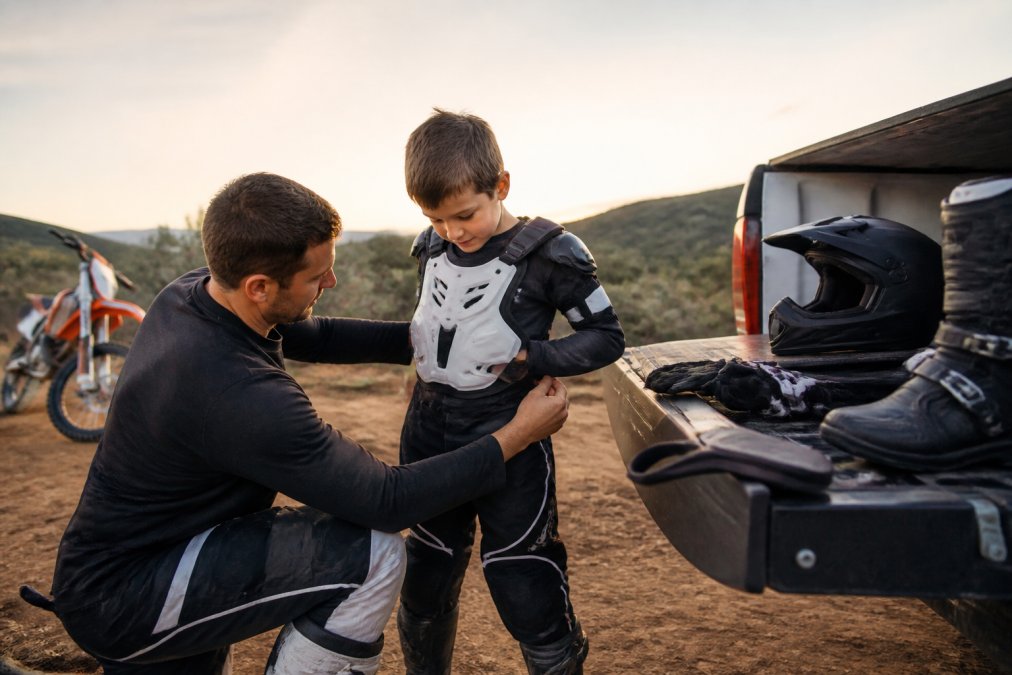
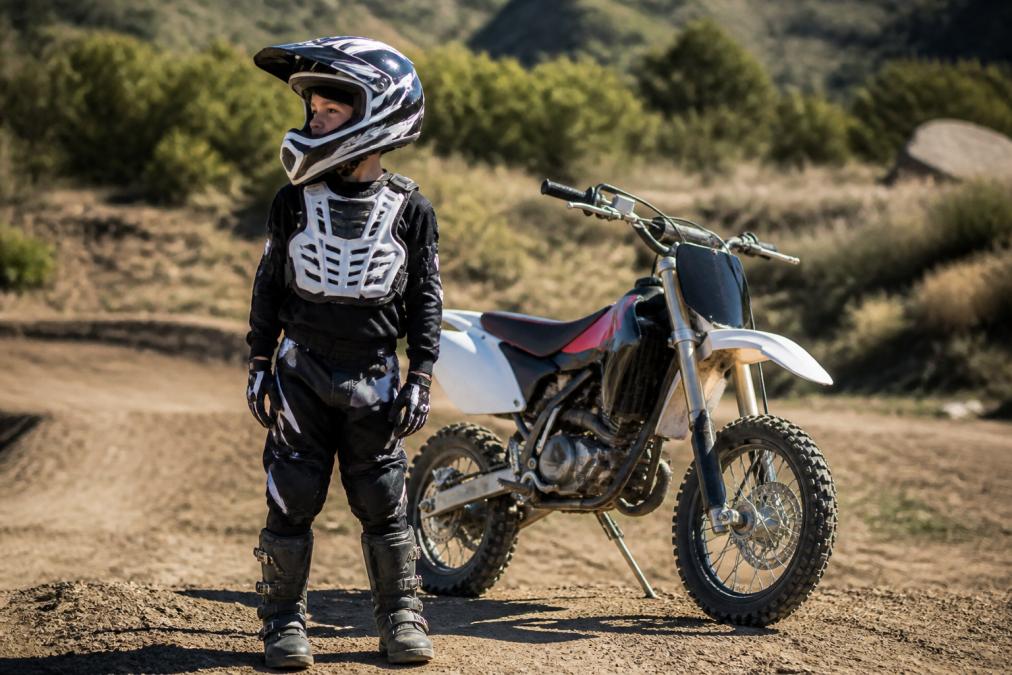
Before a single ride, every young motocross rider needs a complete set of protective equipment: a full-face helmet, motocross boots, goggles, a chest protector, elbow guards, knee braces or guards, gloves, and a neck brace. Each piece serves a distinct purpose, and omitting one creates a dangerous gap in coverage.

Helmet, Boots, and Goggles: The Big Three
The helmet is the most critical piece of motocross gear for kids. It must be a full-face design with a chin bar, because roost, branches, and impacts all target the lower face. Boots are the second priority: youth motocross boots provide ankle support and a reinforced toe box that protects against the weight of the bike. Goggles are third, protecting the eyes from dirt, debris, and UV rays while also preventing wind from drying out the eyes during long rides.
Body Armor: Chest, Back, and Limb Protection
A chest protector shields the ribs, sternum, and upper back from roost and direct impacts. Many youth models also integrate back protection, which is vital because a fall backward onto a rock or root can cause serious spinal injury. Elbow guards and knee braces protect the joints that take the hardest hits during a fall, and gloves prevent blisters while also protecting the palms during a slide.
Youth Motocross Helmet Safety Standards Explained
For youth motocross helmets sold in the U.S., you will primarily encounter three certification marks: DOT, Snell, and ECE 22.05/22.06. Understanding what each tests, and what it doesn't, is critical to making an informed choice.
DOT (FMVSS 218)
This is the mandatory federal standard for all motorcycle helmets sold in the U.S. The DOT tests for impact attenuation, penetration resistance, and retention system strength. However, testing is done at a single impact energy level, and manufacturers self-certify. A DOT sticker is your legal floor, not necessarily a mark of premium protection.
Snell Memorial Foundation (M2025)
Snell is a private, non-profit organization that sets a significantly more rigorous voluntary standard. A Snell-certified helmet is subjected to higher impact velocities, multiple impacts to the same spot, and a more stringent chin bar test. A Snell sticker means independent, third-party testing to a much higher bar than DOT.
ECE 22.05/22.06
This is the UN Economic Commission for Europe standard, the legal requirement in over 50 countries. The current ECE 22.06 standard notably includes testing for rotational forces and impacts at various angles, closer to real-world crashes than the perpendicular drops of the DOT test. A helmet with both DOT and ECE 22.06 offers a broader spectrum of tested protection.
The 'Youth' Factor
Here is where most generic guides stop, but the youth-specific nuance is critical. A child's head is not just a smaller adult head; it is proportionally heavier, has a different center of gravity, and their neck muscles are significantly weaker. A helmet that passes a standard for an adult's neck strength may still allow for excessive rotational acceleration on a child's neck. Because of this, the fit and weight of the helmet are just as important as the certification sticker. A heavier helmet that meets Snell may actually be a worse choice for a small child than a lighter helmet that meets DOT and ECE, because the extra mass increases the leverage on the cervical spine during a crash. When you are evaluating options, look for the certification label inside the shell, and understand that a helmet carrying only a CE mark may not meet DOT requirements. The Consumer Product Safety Commission guidelines on helmet certification provide a useful baseline for understanding what these labels mean.
For most parents, DOT is the minimum acceptable choice, and Snell offers an additional layer of verified protection. However, the best helmet fits perfectly, is lightweight, and meets at least DOT, preferably with ECE 22.06 for rotational force protection. Do not buy a helmet too big just to get a 'better' certification; a loose helmet is a dangerous helmet.
Understanding the Importance of Neck Braces for Youth Riders
The importance of neck braces for youth riders comes down to physics: a child's head is proportionally larger and heavier than an adult's, placing significant stress on the cervical spine during a crash. A neck brace transfers some impact energy away from the neck and distributes it across the chest and back, reducing the range of motion that leads to hyperflexion and hyperextension injuries.
When fitting a neck brace, the device should sit snugly against the collarbone and the base of the skull without restricting the rider's ability to look forward. The brace must be worn over the chest protector but under the jersey. A poorly fitted brace that moves around is worse than none at all, because it gives a false sense of security. As your child grows, check the fit of the neck brace at the start of every season, since a brace that fit in the spring may be too tight by fall.
Motocross Gear Sizing Guide for Children: Fit for Growth
Kids do not grow evenly: a child may be in a size 10 jersey but a size 13 boot. Measure each body part individually and match each piece of gear to those measurements. Do not buy gear several sizes too large with the intention of "growing into it," because oversized protective gear does not protect properly.
The table below summarizes the key fit checks for each major piece of gear.
| Gear Piece | Critical Fit Check | Common Sizing Mistake |
|---|---|---|
| Helmet | Cheeks pads touch cheeks, no movement when shaking head | Buying a size up for growth |
| Boots | Heel stays planted, toes do not crush against the end | Choosing shoes size instead of boot size |
| Chest Protector | Covers full ribcage, does not ride up when arms raise | Ignoring adjustable side straps |
| Goggles | Seal fully around eyes, no gaps at temples | Skipping try-on with the helmet |
| Gloves | Snug palm, no excess material at fingertips | Buying too large for comfort |
The Growth-Stage Sizing System
A full set of youth gear can cost $400-$700, and a child can outgrow it in a single season. To manage this, prioritize adjustability and staged purchasing with this growth-stage approach:
Stage 1: The 'Buy Big' Items (Chest Protector, Knee Guards, Boots) These items have the most adjustability. A high-quality youth chest protector often has sliding shoulder plates and adjustable side straps that accommodate 2-3 inches of torso growth. Youth motocross boots typically have a wider calf adjustment range and can last two seasons if bought slightly larger in the toe box (but not so large that the heel lifts). Buy at the top of the current size range to maximize lifespan.

Stage 2: The 'Buy Exact' Items (Helmet, Goggles) Never buy a helmet or goggles with room to grow. A helmet that is too large will rotate on the head during a crash, rendering it useless. Goggles that are too big will gap at the temples, letting dust reach the eyes. These items must fit perfectly at purchase. Budget for replacing a helmet every 1-2 years, not because it wears out, but because the child's head circumference will outgrow the shell.
Stage 3: The 'Buy Cheap' Items (Jerseys, Pants, Gloves) These are the items kids blow through fastest, from both growth and wear-and-tear. There is no safety penalty for a slightly snug jersey, so do not overspend here. Look for jerseys with stretch panels, and buy gloves that are snug but not restrictive. You will likely replace these mid-season.
How to Check Helmet Fit at Home
The home helmet check takes 60 seconds. Place the helmet on the child's head and fasten the chin strap. It should sit level, about one finger width above the eyebrows. Ask the child to shake their head side to side; the skin on their forehead should move with the helmet, not slide against it. Then try to roll the helmet off by pushing up on the back edge. If it moves enough to expose the forehead, it is too loose.
Boot Fit: Heel, Toe, and Calf Checks
Boots are the most commonly misfit piece of youth motocross gear. With the child wearing the same thin socks they will ride in, slide the foot into the boot. The heel should sit firmly in the heel pocket with no lift when the child stands on their toes. The toes should have a small amount of space, but not so much that the foot slides forward. The calf should fit snugly without pinching, and the buckles should close without excessive force.
The 'Hand-Me-Down' Rule
Helmets and any gear with impact-absorbing foam (chest protectors, knee guards) should never be passed down if they have been involved in a crash. The foam compresses on impact and does not recover. Hard plastic shells on boots and chest protectors are fine to reuse, but any soft padding that has flattened or cracked must be replaced. When in doubt, replace it out.
Gear Maintenance and Replacement: When to Upgrade
Protective gear degrades with use; sunlight, sweat, and impacts break down the materials that provide protection. A helmet that has been dropped hard or involved in a crash should be replaced immediately, even if it looks fine. The foam liner compresses on impact and does not recover, so a second impact in the same spot transfers more energy to the head.
A practical replacement schedule helps: replace the helmet every three to five years from the date of manufacture, regardless of use, because the adhesives and foams age. Boots should be replaced when the sole wears smooth or the ankle support feels flexed out. Chest protectors and pads should be checked for cracks in the plastic shells and replaced when the padding has flattened. Guidance on helmet lifespan and replacement from the Snell Memorial Foundation recommends following the manufacturer's date code for safe service life.
Common Mistakes Parents Make When Buying Gear
The most common mistake is prioritizing the bike over the rider's protection. A faster bike with a cheap helmet is worse than a slower bike with premium protection. A second frequent error is ignoring goggle fit relative to the helmet; goggles that do not seal allow dust to reach the eyes, causing a rider to wipe their face mid-ride and lose control.
Parents also underestimate the importance of moisture-wicking base layers. Cotton t-shirts absorb sweat and chill the rider when they stop, leading to discomfort and distraction. Breathable, moisture-wicking fabrics under the protective gear keep a young rider comfortable and focused. Finally, do not skip the psychological comfort factor: a child who feels restricted will resist wearing their gear, and a rider who fights their gear is not paying attention to the track.
Conclusion: Build the Habit of Safety Early
Choosing protective motocross gear for kids is not a single purchase; it is an ongoing commitment that evolves as your child grows. Checking fit, inspecting for damage, and replacing worn gear should be as routine as checking tire air pressure. When you build safety into the routine from the first ride, it becomes second nature.
At Monarch Sandbox, we carry a curated selection of youth protection, from the Youth Fleet Helmet with its durable PC/ABS shell to the A 5 S Youth Chest Protector with Level 2 CE/UKCA certified protection, plus options like the Youth Tech 7s Boots and Youth Titan Sport Elbow Pads. Every product we stock is chosen for its safety credentials and its ability to withstand real off-road use, so you can trust that the gear meets the standards, not just the marketing hype. CPSC guide on selecting safe sports equipment for children
Get started with Monarch Sandbox today and equip your young rider with protection that performs when it matters most.
Frequently Asked Questions
What is the most important piece of safety gear for a child rider?
The helmet is the most critical piece of protective motocross gear for kids. It protects the head and brain from impacts that can cause life-altering injuries. A properly fitted, certified full-face helmet is non-negotiable for any ride, regardless of distance or speed. Look for helmets meeting DOT or ECE safety standards, and replace them after any significant impact or every few years as materials degrade.
How should a youth motocross helmet fit for maximum safety?
A youth motocross helmet should fit snugly without pressure points. When you shake your head, the helmet should move with you, not slide around. Cheek pads should touch the cheeks firmly. Your child should be able to fit one finger between the chin strap and their throat. The helmet should sit level on the head with the top edge about one finger-width above the eyebrows.
Are there specific safety standards to look for in youth motocross gear?
Yes. Look for DOT (Department of Transportation) or ECE (Economic Commission for Europe) certification on helmets. For body armor like the Alpinestars A-5 S Youth Chest Protector, check for CE (Conformité Européenne) Level 1 or Level 2 ratings on impact protection. These certifications mean the gear has passed independent testing for impact absorption and penetration resistance.
How often should you replace a child's motocross helmet?
Replace a youth motocross helmet every 3-5 years from the manufacturing date, even if it looks fine. The materials break down over time. You must also replace it immediately after any significant impact, even if there are no visible cracks. Since children grow quickly, check the fit every few months. If the helmet becomes loose, it is time for a new one.
What is the difference between a chest protector and a roost deflector?
A roost deflector is a lightweight plastic shell that primarily protects against flying rocks, dirt, and debris kicked up by other bikes. A chest protector offers this same deflection but adds impact protection with padded armor rated to absorb energy from falls and collisions. For youth riders, a certified chest protector provides more comprehensive safety and is the better choice.
How do I know if my child's motocross boots fit correctly?
With new motocross boots, your child's toes should be close to the end with minimal extra space, roughly a thumb's width shorter than street shoes. Their heel should sit firmly in the boot without lifting. Have them stand and flex their knees: the boot should allow forward ankle movement without excessive side-to-side play. The calf should fit snugly without cutting off circulation.