 listicle
5 Best Youth Dirt Bike Chest Protectors for Young Riders
Table of Contents
- Quick Comparison: 5 Best Youth Dirt Bike Chest Protectors
- How We Evaluated These Youth Chest Protectors
- 1. A 5 S Youth Chest Protector: Best Overall Impact Protection
- 2. Youth Ce Revel Roost Guard: Best Low-Profile Roost Guard
- 3. Youth Airframe Chest Guard: Best for Ages 6-14
- 4. Bionic Tech Youth Protection Jacket: Best Full-Body Jacket
- 5. Youth Bantam Roost Deflector: Best Budget Youth Chest Protector
- Roost Guard vs Chest Protector: Which Does Your Young Rider Need?
- Frequently Asked Questions
Last Updated: October 1, 2026
Quick Comparison: 5 Best Youth Dirt Bike Chest Protectors
Finding the 5 best youth dirt bike chest protectors starts with one question: does the guard carry certified impact protection, or just plastic and marketing? Every pick below is CE rated, sized for young riders, and stocked through Monarch Sandbox, the gear shop powered by Monarch Honda and Monarch Powersports. Below, we break down fit, coverage, and price so you can match a guard to your rider's age, bike, and budget.
| Protector | Price | Certification | Best For |
|---|---|---|---|
| A 5 S Youth Chest Protector | $179.95 | Chest Level 2, Back Level 2, Shoulder Level 1 | Maximum certified impact protection |
| Youth Ce Revel Roost Guard | $159.95 | Back Level 1, chest and back roost coverage | Low-profile roost guard |
| Youth Airframe Chest Guard | $174.95 | Chest and back Level 1 Koroyd | Riders ages 6-14 |
| Bionic Tech Youth Protection Jacket | $249.95 | CE and UKCA certified | Full upper-body jacket coverage |
| Youth Bantam Roost Deflector | $55.00 | Biofoam and TPR shield | Budget-conscious families |
How We Evaluated These Youth Chest Protectors
Each guard was judged on four things: certification level, coverage area, ventilation, and how well it fits a growing kid. Certification came first. A protector without a CE rating is a jersey with extra plastic, no matter how it looks on the rack.

Coverage mattered next. Chest, back, shoulders, and ribs all take hits in a crash, and the best guards protect more than one zone. Ventilation decided the rest. A hot, sweaty kid pulls at straps and shifts the guard out of position, which defeats the purpose.
Fit got the final vote. Young riders grow fast, so adjustment range matters as much as the size on the label.
1. A 5 S Youth Chest Protector: Best Overall Impact Protection
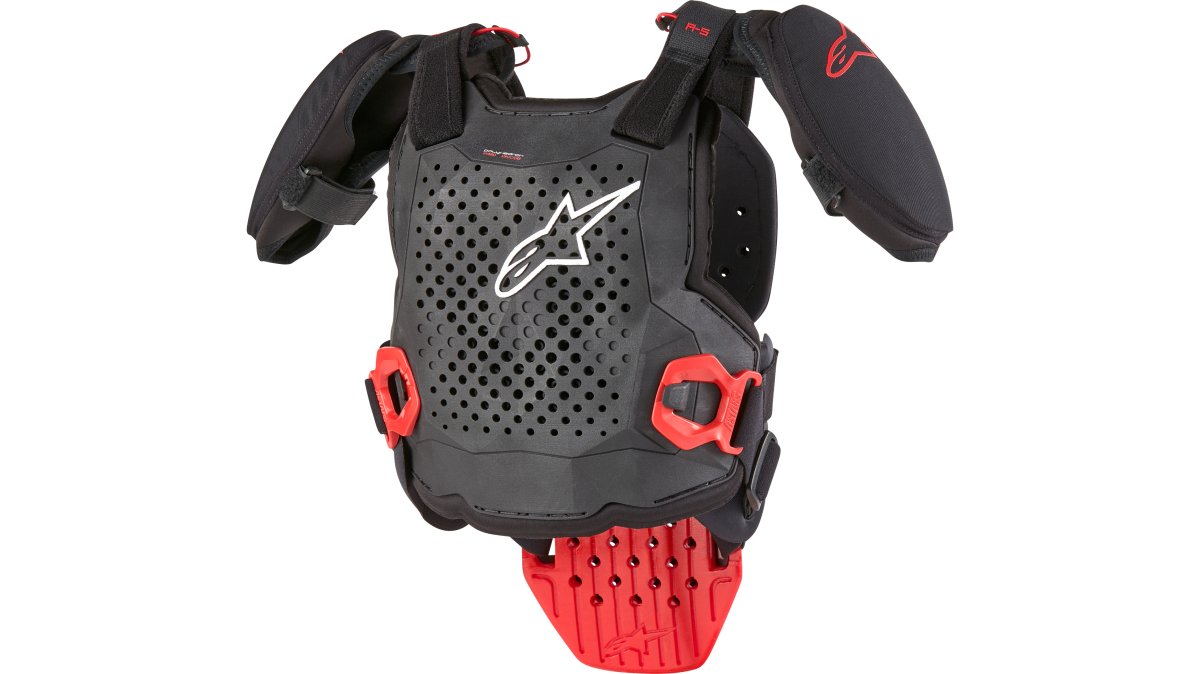
The A 5 S V2 is the only guard here with Level 2 certification on both chest and back, which makes it the strongest pick for hard-charging riders. The detachable floating chest plate uses Polyhedron Hybrid Technology: a rigid center zone spreads impact force while a soft outer compound molds to the body.
Certification runs deep on this one. The back protector is EN 1621-2:2014 Level 2, the chest is EN 1621-3:2018 Level 2, and the shoulder cups are EN 1621-1:2012 Level 1. The viscoelastic back protector flexes with the spine instead of fighting it, and contoured bio-foam rib guards add side coverage most guards skip.
Ventilation is where the A 5 S surprises people. Roughly 17% of the structure is ventilation apertures aligned through the hybrid layers, and the zone behind the perforated inner grid is completely open. Adjustable shoulder straps and a V-strap system spread tightening force across a wider area of the back, so the guard stays put instead of digging in. It is also YNS compatible through a removable puck panel.
What works: The highest certified protection level in this lineup, plus the lightest Level 2 chest protector in its class. What doesn't: At $179.95 it costs more than the Bantam, and younger riders may find the full coverage more guard than they need.
2. Youth Ce Revel Roost Guard: Best Low-Profile Roost Guard
Fly Racing built this guard to disappear under a jersey. The low-profile chassis slides beneath the plastics or removes entirely for neck brace users, and the BioFoam attachment system eliminates the plastic rivets that can dig into a rider during impact.
The triple-layer chest construction sandwiches high-density memory foam between the outer plastic and the body-side BioFoam. Because the layers move independently, the guard absorbs impact energy better than a single thick slab. Air channels molded into the BioFoam push hot air out, and multiple vents run throughout the chassis.
Certification covers EN1621-2 Level 1 for the back plus FprEN1621-3 and Me-Int 097 for the chest. Adjustable shoulder straps and waist buckles integrated into the chest plastic keep the fit clean. At $159.95, it is the best choice for a rider who wants roost protection without bulk.
What works: Genuinely wearable under a jersey, and the removable BioFoam chassis washes easily. What doesn't: Back protection is Level 1, not Level 2, so it trails the A 5 S on certified impact absorption.
3. Youth Airframe Chest Guard: Best for Ages 6-14
The Airframe is the pick for families buying one guard that will last through a growth spurt. It is designed for ages 6-14, with adjustable shoulder straps and a waistband using fast-action buckles that loosen and tighten in seconds.
CE Level 1 Koroyd inserts sit in both the chest and back. Koroyd crushes on impact to absorb energy, and the body-conforming fit keeps the guard close instead of sliding around.
4. Bionic Tech Youth Protection Jacket: Best Full-Body Jacket
A jacket beats a chest plate when you want protection that cannot shift out of place. The Bionic Tech wraps the torso in Cell Technology, with a divided, highly perforated chest protector and a triple-segment back protector that bends with the spine.
5. Youth Bantam Roost Deflector: Best Budget Youth Chest Protector
Safety should not be a luxury, and the Bantam proves it does not have to be. At $55.00, it costs roughly a third of the A 5 S while still delivering a Biofoam barrier, a TPR shield over critical areas, and a form-fitting cut that stays against the body.
Roost Guard vs Chest Protector: Which Does Your Young Rider Need?
The two terms get used interchangeably at the track, but they describe different jobs. A roost guard is a deflector: a hard outer shell that knocks down rocks, clods, and roost thrown by other bikes. A chest protector is an impact absorber: a certified pad that manages the energy of the crash itself, the moment a rider goes over the bars or lands on them.
The three categories you will see on the rack
Roost deflectors. Hard plastic shell, minimal or no certified padding, light and highly ventilated. The Youth Bantam Roost Deflector is the classic example at $55.00: Biofoam and a TPR shield over critical areas, no published CE level. These are built for the debris threat, not the hard-landing threat.
Match the category to how your rider actually crashes
A common pattern in youth crashes is the low-side: the front wheel washes out, the rider goes down on a shoulder and slides. That is a roost-and-abrasion event, and a deflector handles it. The high-side is the one that hurts: the bike hooks up, the rider gets launched, and the landing drives the bars or the ground into the chest.
What you give up at the entry level
The honest trade-off at the budget end is certified impact absorption. A $55.00 deflector will stop a rock and survive a tip-over, but it carries no published CE level, so there is no tested number for how much energy it absorbs. Moving up to a Level 1 certified guard buys you a tested threshold. Moving up again to Level 2 roughly doubles the certified impact energy absorption over Level 1 under the EN 1621 standard.
Under the jersey or over it?
This is the layering question most guides skip, and it changes both comfort and safety. Under-jersey guards (the Revel, the Bantam) sit against the body, which keeps them from snagging on branches and lets a jersey breathe over the top. The downside is that a jersey can bunch the guard out of position, and you cannot reach the straps to adjust mid-moto.
Frequently Asked Questions
What is the best chest protector for youth motocross?
The best choice depends on the rider's age and riding style. The A 5 S Youth Chest Protector ($179.95) offers Level 2 CE protection on the chest and back, making it a strong pick for competitive motocross. The Youth Airframe Chest Guard ($174.95) suits ages 6-14 with CE Level 1 Koroyd inserts and removable collarbone pads. For tight budgets, the Youth Bantam Roost Deflector ($55.00) provides Biofoam and TPR shield coverage without the higher price.
What is the difference between a roost guard and a full chest protector?
A roost guard is a hard outer shell that deflects rocks, dirt, and debris thrown up by other bikes, and it usually fits over or under a jersey. A full chest protector adds certified impact foam and often a back protector, so it absorbs crash energy rather than just blocking debris. The Youth Ce Revel Roost Guard ($159.95) is a low-profile roost guard with CE-rated foam layers, while the Bionic Tech Youth Protection Jacket ($249.95) is a full-coverage option with a triple-segment back protector.
Do youth chest protectors meet specific safety standards?
Yes. CE-rated youth chest protectors are tested against European standards that the US market also recognizes: EN 1621-1 for shoulder and limb protectors, EN 1621-2 for back protectors, and EN 1621-3 for chest protectors. The A 5 S Youth Chest Protector, for example, carries EN 1621-1 Level 1 shoulder, EN 1621-2 Level 2 back, and EN 1621-3 Level 2 chest ratings. Always check the product label for the specific standard and level before buying.
How do I choose the right size chest protector for my child?
Measure your child's chest circumference at the widest point and compare it to the manufacturer's size chart, then check the shoulder strap range. Adjustable straps and elastic closures, like those on the Youth Airframe Chest Guard and the Sentinel Pro Guard, let you fine-tune the fit as your child grows. The protector should sit snug against the torso without restricting arm movement or breathing, and the bottom edge should not dig into the waist when seated on the bike.
How often should I replace my child's dirt bike chest protector?
Replace the protector after any significant crash where the shell cracks, the foam compresses permanently, or straps and buckles stop holding tension. Even without a crash, check the foam and plastic every season for hardening, cracking, or stretched elastic. Because children grow quickly, a protector that no longer sits flat against the chest or that leaves gaps at the shoulders should be replaced. Growth-stage adjustment is fine, but a visibly loose fit means it is time for a new size.